Two homes go on the market in St Andrews Country Club within the same month. Similar lot size, similar golf course frontage, asking prices forty thousand dollars apart. One closes in six weeks. The other is still sitting at the ninety-day mark, price reduced once already, showings slowing down. The difference has nothing to do with staging or the listing photos. It has to do with the year a permit was pulled.
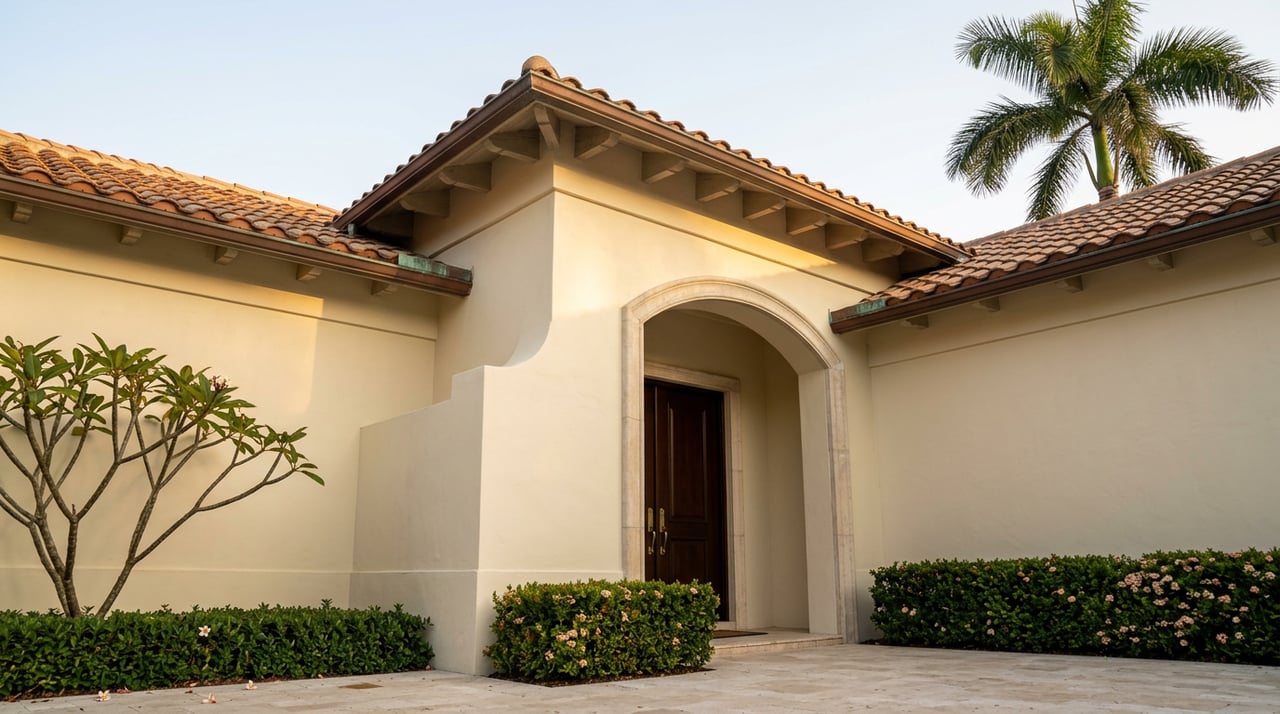
St Andrews was established in 1982, and its original inventory, the Spanish Revival estates built by period builders like Bloomfield, Leonard Albanese, Tuscan Homes, Audubon, and Frankel Homes, is now well into its fifth decade. Those homes were built with tile roofs, which is the reason many of them are still standing and still insurable at all. But forty-plus years is a number that catches up with even the most durable roofing material, and in 2026, roof age has become the single variable most likely to determine how fast a St Andrews listing moves and what it actually closes for.
The number that doesn't square with the address
Over the trailing year through early 2026, 31 homes sold in St Andrews Country Club at an average price near $4.41 million and roughly $671 per square foot, with a list-to-sell ratio of 91 percent. That ratio is healthy. What isn't healthy, by the standards of the address, is the marketing time. Those same sales averaged 96 days on market, well above the 33-day median for Boca Raton's broader luxury tier.
A community with a 91 percent list-to-sell ratio should not need three times longer than the surrounding luxury market to close a deal. Sellers and agents unfamiliar with the community tend to explain the gap with prestige, assuming buyers simply take longer to commit to a $400,000 non-refundable initiation fee on top of a multimillion-dollar home. That's part of it. But it isn't the whole story, and it isn't the part a seller can do anything about. The part a seller can act on is which of St Andrews' three real submarkets their home actually belongs to, because each one carries a different roof-age profile, and that profile is doing more to set the marketing clock than the golf course view ever will.
One gate, three very different products
Walk the neighborhood and you'll find three distinct products wearing the same 720-acre address:
- Original 1980s estates on premium lots. These trade close to land value, typically starting around $600,000 and running past $10 million depending on the lot, and buyers on this path are pricing the dirt and the entitlement, not the house. Most are purchased with the roof, and often the structure, headed for teardown.
- Renovated one-story resales. Rebuilt with impact glass, a new roof, and an updated kitchen, these sit in the $3 million to $6 million range and tend to absorb the shortest marketing time in the community. This is where that 91 percent list-to-sell ratio actually holds up.
- New luxury construction. Fully modern builds, some by architect Randall Stofft, others delivered by Reich Construction Group or built as custom Cudmore Homes estates in the Lake Estates section, push into the $6 million to $19.9 million range.
Those three tiers aren't a marketing convenience. They're a roof-age map. The teardown-priced originals carry roofs old enough that insurers treat them as a liability the buyer inherits on day one. The renovated resales reset that clock with a new roof during the remodel, which is exactly why they move fastest. The new construction sits so far inside every underwriting threshold that insurance barely enters the conversation.
Why the roof, specifically, is the fault line
Florida law sets limits on when an insurer can refuse to issue or renew a policy based on roof age, and insurers may require an inspection as roofs age. Citizens Property Insurance Corporation, the state's insurer of last resort, requires a four-point inspection, covering roof, electrical, plumbing, and HVAC, on most applications for homes over 20 years old, and asks for additional roof documentation on shingle roofs past 25 years and tile, slate, or metal roofs past 50. As of applications with effective dates from August 1, 2026, Citizens can also pull the year of the last roof update directly from third-party data, which means a homeowner without clean permit records no longer gets the benefit of the doubt.
That 50-year tile allowance sounds generous, and against a shingle roof's 15 to 20 year lifespan in South Florida's UV exposure, it is. It's also the reason St Andrews' original Spanish Revival stock has stayed insurable this long at all. But private carriers routinely apply scrutiny well before Citizens' formal ceiling, and a standalone four-point inspection, running roughly $125 to $300 in most South Florida markets, tends to surface exactly the kind of aging condition an underwriter flags: original tile nearing the end of its practical life, an electrical panel that predates current code, plumbing that has never been documented. None of that shows up in a listing photo. All of it shows up the moment a buyer's insurance agent starts asking for paperwork.
What this means before the sign goes in the yard
For a seller with an original-era St Andrews home, the roof conversation isn't optional anymore, it's the first conversation. A four-point inspection ordered before listing, alongside documentation of the roof's install date and any permitted work, does two things a buyer's financing timeline actually needs: it gives a lender-facing insurance quote something concrete to underwrite against, and it tells a buyer up front whether they're purchasing a livable house or a well-located teardown. Sellers who skip this step often find out the hard way, midway through a contract, when a buyer's insurance carrier comes back with a decline or an actual cash value endorsement that changes the buyer's math entirely.
For a seller whose home already went through a renovation with a new roof, the opposite is true. That paperwork is now a selling point worth featuring prominently, not burying in disclosures, because it's the difference between competing in the fast-moving $3 million to $6 million tier and getting lumped in with properties priced for demolition.
What this means for a buyer comparing two listings
A buyer weighing an original-era estate against a renovated resale at a similar price should ask for the roof's install date and any four-point inspection on file before writing an offer, not after. The answer determines whether the purchase price reflects a house or a lot, and whether the insurance quote that arrives during underwriting will match what the listing implied.
A few questions worth asking directly
Does a tile roof automatically qualify for St Andrews' original homes? Not automatically. Citizens' documentation threshold for tile runs to 50 years, but many private carriers apply their own, tighter scrutiny well before that point, particularly on homes over 40 years old.
Is a four-point inspection the same as a full home inspection? No. A four-point inspection documents the condition of the roof, electrical, plumbing, and HVAC systems specifically for insurance underwriting. A full home inspection covers considerably more and serves the buyer's due diligence, not the insurer's risk assessment.
Does a newer roof change what a home is worth in St Andrews? It changes what a home is insurable as, which in this market has become inseparable from what it's marketable as. The renovated resale tier's shorter marketing time reflects that directly.
If you're weighing an original-era St Andrews estate, a renovated resale, or a new-construction listing, and want a clear read on where a specific address falls on this roof-age line before you write an offer or list a home, the Ina Bloom Team can walk through the documentation with you and connect you to the inspection and insurance resources that make the difference at closing. Request a private consultation to start that conversation.
This article is general information, not legal, tax or financial advice. Consult a qualified professional about your situation.